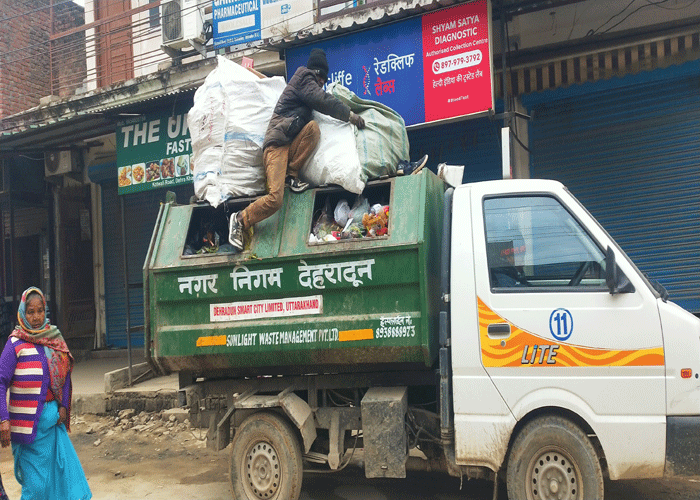
Uttarakhand continues to struggle with a massive legacy waste problem, with around 12.82 lakh metric tonnes of old garbage lying across more than 50 dumping sites in the state. Despite repeated plans and funding approvals, no city in Uttarakhand has been able to completely clear its legacy waste so far. The slow pace of disposal is now emerging as a serious threat to the environment, groundwater and public health.
In contrast, Uttar Pradesh’s capital Lucknow has set an example by clearing nearly 6.5 lakh metric tonnes of accumulated waste within just six months. The Shivri dumping site, once known as a mountain of garbage, has now been transformed into a national-level inspiration site. This achievement has brought the “Lucknow Model” into focus as a possible solution for Uttarakhand’s worsening waste crisis.
Data shows that only about 27 percent of the legacy waste lying at Uttarakhand’s dumping sites has been processed. More than 12 lakh metric tonnes of garbage remains exposed in the open. Dehradun and Haridwar account for the largest share of this waste, but the situation in hill districts is equally worrying. In districts like Almora, Bageshwar and Pithoragarh, legacy waste disposal is still at an early stage with minimal progress on the ground.
Under Swachh Bharat Mission 2.0, detailed project reports have been approved for 14 projects across 13 urban local bodies, and funds have been released for eight dumping sites. However, execution delays, technical hurdles and administrative bottlenecks have slowed down the work. In several locations, projects are either incomplete or moving at a very slow pace.
The Lucknow success story holds a special connection for Uttarakhand. Lucknow Mayor Sushma Kharkwal, who hails from Uttarakhand, played a key role in driving the initiative. She studied legacy waste processing models in Pune and pushed for time-bound execution in Lucknow. Her approach turned an abandoned and polluted dumping ground into a usable public space, something Uttarakhand cities have yet to achieve.
According to official figures, Dehradun has around 7,14,418 metric tonnes of legacy waste, while Haridwar has 3,30,586 metric tonnes. Nainital accounts for about 79,500 metric tonnes, Pithoragarh 39,508 metric tonnes and Udham Singh Nagar around 11,000 metric tonnes. These figures underline the scale of the challenge stretching from Garhwal to Kumaon.
Also Read This – Kedarnath Reconstruction Continues at -10°C as January Sees Unusual Lack of Snow
Urban Development Department officials say new waste processing plants will become operational soon and that delays were caused by multiple obstacles. They claim the situation is expected to improve in the coming months. However, experts believe that without strong political will and strict timelines, Uttarakhand may continue to lag behind, making the Lucknow model the only proven roadmap left to tackle the growing garbage crisis.