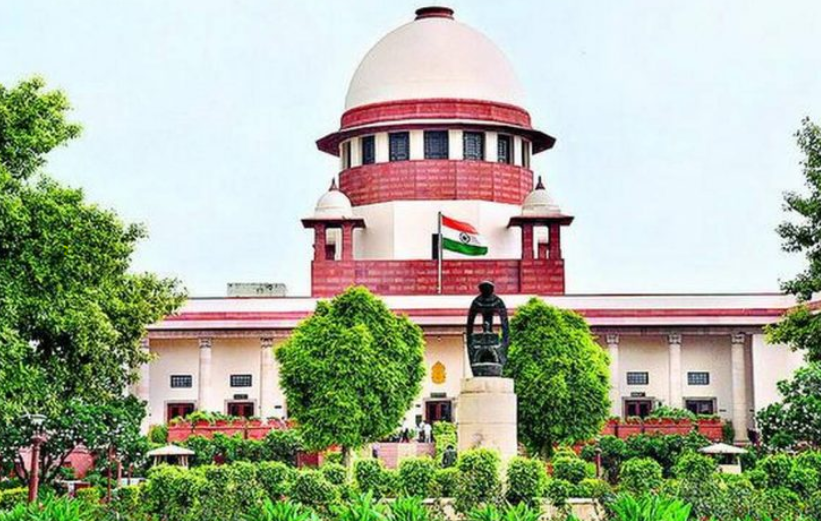
The Supreme Court has agreed to examine a public interest litigation (PIL) challenging the constitutional validity of the sedition provision under the Bharatiya Nyaya Sanhita (BNS). The court has sought a response from the Central government regarding this matter.
Retired Major General S.G. Vombatkere filed the PIL against Section 152 of the BNS, which deals with acts endangering India’s sovereignty, unity, and integrity. A bench comprising Chief Justice B.R. Gavai, Justice K. Vinod Chandran, and Justice N.V. Anjaria took cognizance of the petition and issued notice to the Centre. The bench also directed that the PIL be clubbed with a pending petition challenging the validity of the repealed Section 124A of the Indian Penal Code (IPC), which also dealt with sedition.
According to Section 152 of the BNS, any individual who deliberately incites secession, armed rebellion, or subversive activities through speech, writing, signs, or visual representation, or participates in such acts, can face life imprisonment or a jail term of up to seven years along with a fine.
The PIL argues that this provision is merely a rebranded version of the colonial-era sedition law and violates Article 19(2) of the Constitution, which governs reasonable restrictions on freedom of speech. The plea contends that Section 152 fails to meet the principles of clarity, necessity, and proportionality and should therefore be struck down.
In July 2022, the Supreme Court, under then Chief Justice N.V. Ramana, had put a temporary halt on the implementation of IPC Section 124A and directed the government to review the provision. The current PIL claims that Section 152 of the BNS is essentially a continuation of the same law, despite the IPC being repealed.