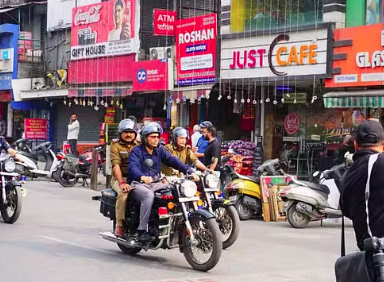
A cycle rally was organized in Dehradun today under the ongoing Wildlife Week to celebrate “Gaj Utsav,” focusing on elephant conservation and spreading awareness about the importance of protecting them and their natural corridors. The event, held by Nature’s Buddy, began from Sauda Saroli and returened from Badassi Pul, a route chosen because elephants frequently cross this area from Rajaji Tiger Reserve, leading to increased human–elephant interactions in recent years.
The rally aimed to educate people about how elephants live and their movement through forests, and why their preservation is essential. Uttarakhand is home to about 1,839 elephants, according to a 2023 report by the Ministry of Environment, Forest and Climate Change. However, the population is under threat due to rapid habitat loss, railway accidents, electric fences, and urban expansion. Just last week, three elephants died in Haridwar, underlining the seriousness of the crisis.
 Nature’s Buddy member Mohit pointed out that railway tracks and high-voltage electric fences have become the biggest killers of elephants in Uttarakhand. He added that human encroachment into forests — whether for roads, flyovers, or housing — has disrupted elephant paths. Since elephants memorize their routes from birth, they continue to follow traditional trails even if human settlements now block their way, causing frequent conflicts.
Experts highlighted the ecological role of elephants, describing them as a keystone species. Their movement creates trails used by other animals, and even humans, while their dung acts as a natural fertilizer enriching the soil. Protecting elephants therefore means safeguarding the health of the entire forest ecosystem.
The Uttarakhand government has officially identified 11 elephant corridors that are critical for safe elephant movement. These corridors are:
- Ravasan–Sonnanadi Corridor (Rajaji–Corbett Corridor) – Connects the forests of Uttar Pradesh and Uttarakhand, linking Sonanadi Wildlife Sanctuary with Rajaji Tiger Reserve.
- Shivalik Corridor – Covers Mohand–Shakumbhri–Barkala near Dehradun, connecting elephants migrating between Uttar Pradesh and Uttarakhand.
- Chilla–Motichoor Corridor – Connects the Chilla and Motichoor ranges of Rajaji Tiger Reserve.
- Motichoor–Gohri Corridor – Links the Motichoor and Gohri ranges within Rajaji Tiger Reserve.
- Teenpani Corridor – Connects Rajaji Tiger Reserve’s Motichoor range with the forests of Barkot and Rishikesh.
- Kilpura–Khatima–Surai Corridor – Connects Haldwani forests, Nandhaur Wildlife Sanctuary, and Pilibhit Tiger Reserve (Uttar Pradesh).
- Kosi River Corridor – Links Corbett Tiger Reserve with forests along the Kosi River in Ramnagar.
- Nihal–Bhakhra Corridor (Fatehpur Gadgadia Corridor) – Connects Ramnagar’s Fatehpur range with Tarai’s Gadgadia forests.
- Kansrau–Barkot (Lal Tappad Corridor) – Links Kansrau range of Rajaji Tiger Reserve with forests near Rishikesh in Dehradun.
- Ravasan–Sonnanadi Corridor (Lansdowne) – Connects Rajaji and Corbett National Park through the Lansdowne forest division.
- Chilkiya–Kota Corridor – Connects Chailia Reserve Forest, Corbett Tiger Reserve, and Kota Reserve Forest near Ramnagar.
Conservationists stressed that these corridors must remain free from encroachment to allow elephants safe passage. They warned that blocking or disrupting corridors with infrastructure projects could not only endanger elephants but also destabilize the entire forest ecosystem.
The rally concluded with a call for collective action to reduce human–elephant conflict. Organizers urged that forests and natural corridors must be preserved to ensure elephants survive in Uttarakhand for generations to come.