Garhwal Post Bureau
Roorkee, 3 Nov: Quantum University, Roorkee, successfully organised an International Conference on Indian Knowledge Systems (ICIKS–2025) from 31 October to 1 November 2025, under the theme “From Ancient Wisdom to Global Sustainability: Unleashing the Potential of Indian Knowledge Systems in the Modern Intellectual Landscape.”
The two-day global academic meet became a vibrant platform where ancient Indian philosophies met contemporary research, reflecting India’s vision for knowledge-based sustainability. Scholars, researchers, and academicians from diverse disciplines came together to reinterpret traditional wisdom through the lens of science, technology, and human development.
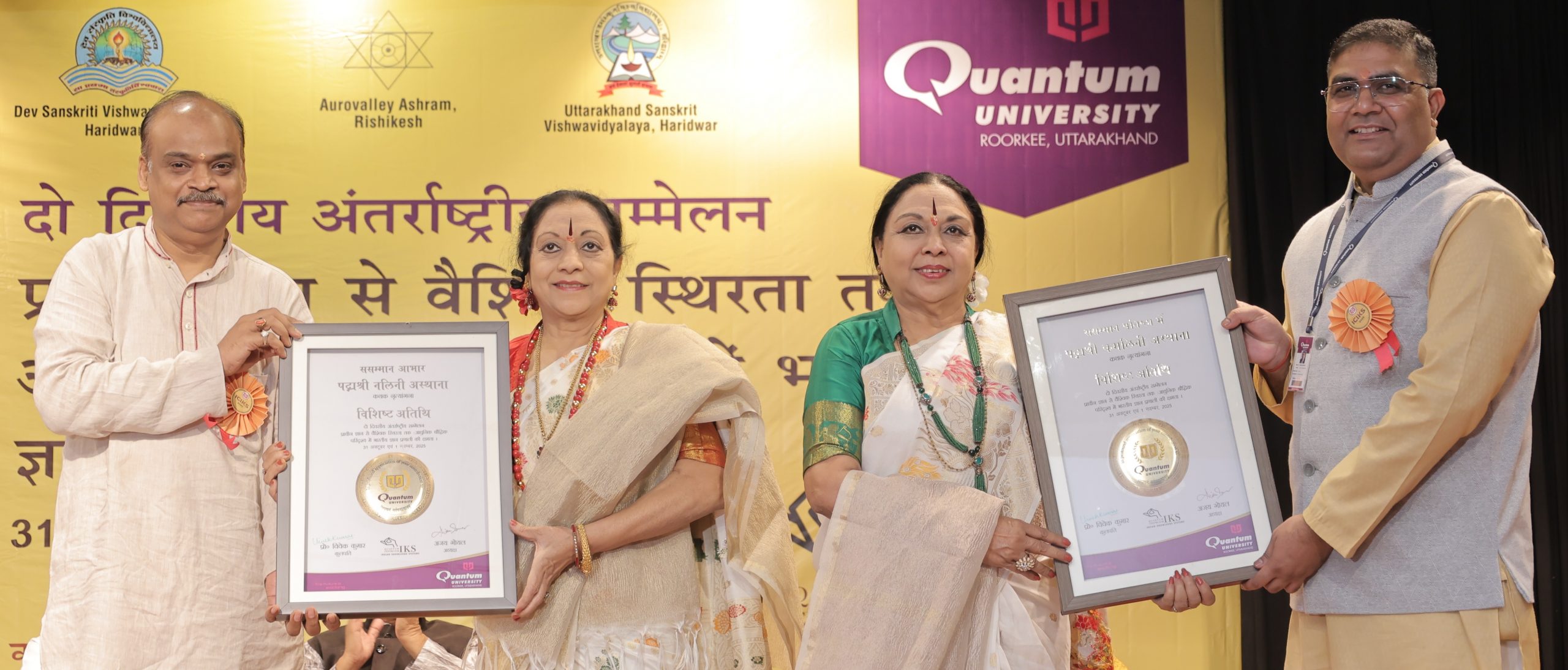
The conference began at the Shyamji Auditorium. Present were Chief Guest Swami Brahmdev, Founder, Aurovalley Ashram, Rishikesh; Guests of Honour Padma awardee Nalini & Kamalini Asthana, a sister duo from Agra in Uttar Pradesh known for their great performances of the Benaras Gharana style of Kathak. Also, Prof Dinesh Chandra Shastri, Vice-Chancellor, Uttarakhand Sanskrit University; and Acharya Pratishtha, leading Yoga & Spiritual Guru of India.
Prof Vivek Kumar, Vice-Chancellor of Quantum University, welcomed the delegates, affirming that Quantum continues to serve as “a bridge between the roots of our civilisation and the wings of modern innovation”.
Sharing his thoughts, Swami Brahmdev said, “Indian Knowledge Systems are not confined to history; they are a consciousness that guides human evolution.” Nalini & Kamalini Asthana spoke on “Art as a bridge between intellect and emotion,” reminding the audience that culture and creativity remain central to India’s identity.
Prof Dinesh Chandra Shastri highlighted the need for “a renewed dialogue between Sanskrit scholarship and modern science.”
Meanwhile, Acharya Pratishtha inspired participants by saying, “Yoga and Indian philosophy teach us balance — something the modern world desperately needs.”
Students from different clubs showcased their cultural performances, bringing art, music, and tradition alive on stage.
A series of thought-provoking paper presentations followed that celebrated the depth of Indian Knowledge Systems through research and innovation.
Under Track 1: Scientific Heritage, chaired by Dr Noopur Jaiswal, scholars presented groundbreaking studies that revived the brilliance of ancient Indian discoveries and connected them meaningfully with modern scientific advancements.
Dr Shine K. George traced the Kerala School’s mathematical lineage in “From Infinite Series to Artificial Intelligence”, while Dr. Mridula and her team explored “From Panini to Python”, connecting Sanskrit grammar to computational linguistics.
Madhulika Mittal’s paper, “From Vedic Mathematics to Machine Learning,” bridged ancient mental math with coding logic.
The session reaffirmed that India’s scientific legacy continues to inspire innovation in AI, linguistics, and sustainability.
Under Track 2: Ayurveda, Health & Wellness, Dr. Shalini Verma, united Ayurveda, psychology, and modern wellness. Dr Mohit Sandhu discussed Agnikarm MIAP for pain management, while Dr Ayush Mittal and Dr Kamal Kishore shared insights on Bhakti Yoga for mental health. Rupali and Mani Narwal presented studies on Ayurvedic nutrition and iron-rich dietary solutions.
Under Track 3: Architectural Wisdom, Dr Raj Kumar, revisited sustainable design principles rooted in Vastu Shastra and temple geometry.
Researchers proposed blending traditional ethics with technology through AI, BIM, and digital heritage tools, affirming that ancient architecture still guides sustainable urban design today.
Under Track 4: Vedic Governance & Ethics, Dr Ankur Sharma, shared his thoughts on Dharmic Leadership and Ethical Governance.
Dr Silali Banerjee examined inclusion through The Ramayana, Dr Akhilesh Yadav linked Dharma and Justice to constitutional values, and Dr Mousmi Goel with Harshil Sharma analysed ancient financial systems.
The session concluded that dharma-based management and morality-driven governance remain crucial for sustainable institutions.
As a special highlight, the Department of Agricultural Studies, Quantum University, organised an Organic Fair as part of the IKS Conference 2025. The fair celebrated India’s rich agricultural heritage while promoting sustainable and innovative farming practices that blend traditional wisdom with modern technology.
Honouring Knowledge and Continuity, the conference concluded on 1 November with a Valedictory Session attended by Dr AK Tripathi (Vice-Chancellor, Uttarakhand Ayurveda Vishwavidyalaya) as Chief Guest and Dr Ram Vinay Singh (Professor, DAV PG College, Dehradun) as Guest of Honour.
In his closing address, Dr Tripathi encouraged researchers to “continue merging traditional roots with contemporary research for the betterment of society.”