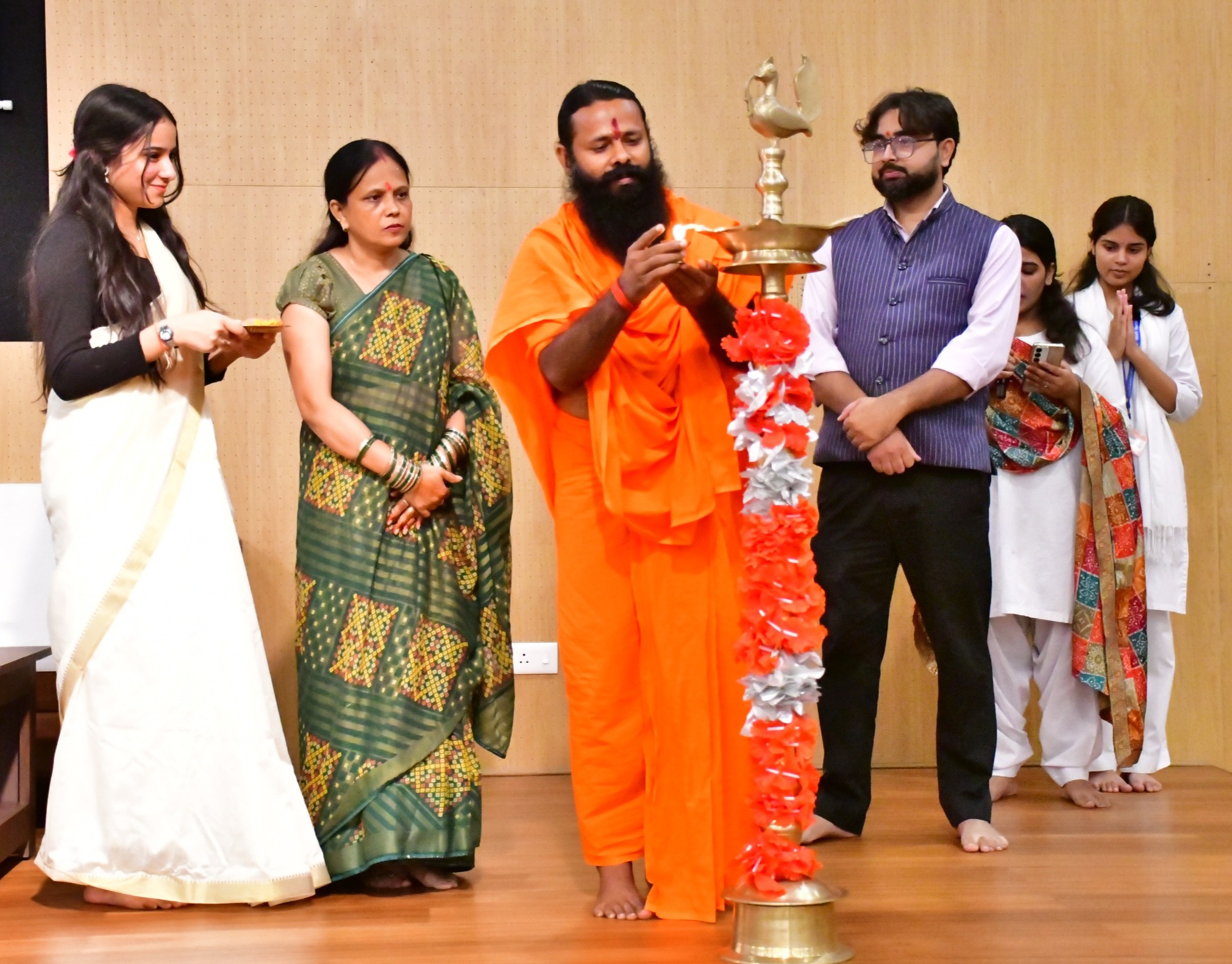
Haridwar, 10 Oct: The Department of Psychology at Patanjali University organised an insightful and motivating workshop on World Mental Health Day, here, today. The objective of the workshop was to sensitise students, faculty members, and society at large towards mental well-being and to highlight effective strategies for managing stress, anxiety, and emotional balance during emergencies and crisis situations.
The programme commenced with Vedic chanting and ceremonial lamp lighting. Welcoming the guests, Dr Vaishali Gaur, Head of Department and Convener of the workshop, said that in today’s era, discussions on mental health are as important as those on physical health.
Dr Jayan Namboothiri, CEO & Director of Mindcraft, joined the session online as the Chief Guest and Keynote Speaker. Delivering a presentation on “Access to Services in Catastrophes and Emergencies”, he emphasised that health is incomplete without mental wellness. Through real-life examples and experiences, he explained how psychological resilience enables individuals to recover faster from natural disasters, accidents, or sudden crises.
He further stated that eight hours of sleep, a balanced nutritious diet, and a cheerful attitude are essential pillars of sound mental health. He clarified that mental wellness does not mean merely being disease-free, but staying emotionally, psychologically, and socially balanced. “If the mind is unstable, self-development becomes impossible,” he added.
Swami Parmarthadev, Chief Central Incharge of Bharat Swabhiman Trust, graced the event as the Guest of Honour. In his inspiring address, he said that mental health in human life holds the same importance as oxygen for the body. Stressing the need for mind control in today’s technology-driven competitive lifestyle, he said, “If we master our mind, no circumstance can disturb us.”
Dr Lokesh Gupta, Associate Professor, Department of Psychology, highlighted the educational and social dimensions of mental health, stating that counselling and awareness programmes for students in universities are the need of the hour. Dr Sanwar Singh, Assistant Professor, Department of Philosophy, also shared his valuable insights.
The workshop witnessed the presence of all Deans, Heads of Departments, teaching and administrative officials, along with a large number of students. Participants described the programme as highly enriching and an opportunity for deep self-reflection.
The event was hosted by Aahana Gupta and Rashi.
The workshop concluded with a collective pledge — that each individual would make mental health an integral part of daily life and contribute towards spreading awareness in society.